
Everything is Dual Use, This Substack Included
Why the term explains almost nothing, why that matters politically, and why Karp is right about the premise and wrong about everything else

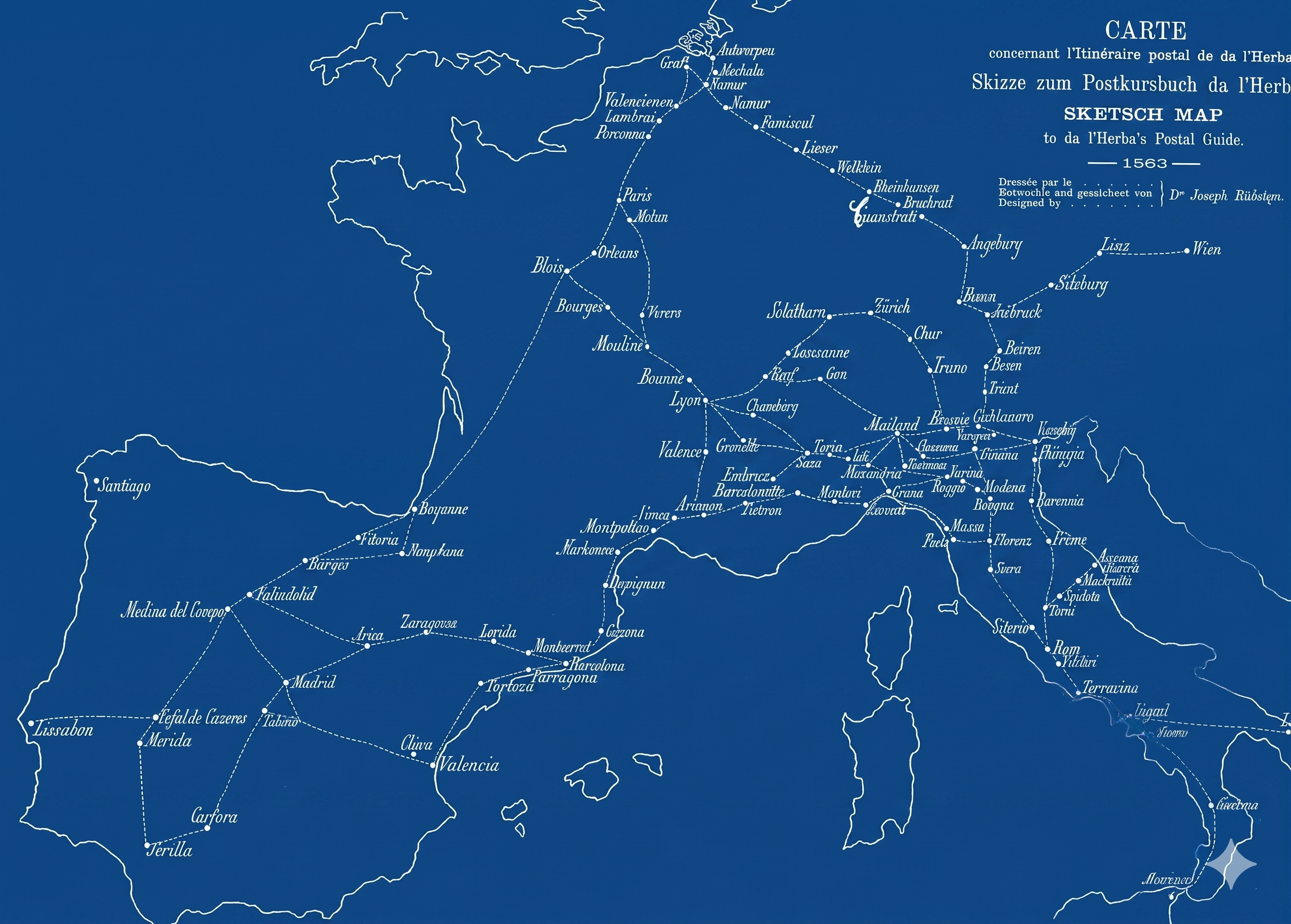
In the late fifteenth century, the Habsburg emperor Maximilian I commissioned a family of Italian merchants from the Alpine foothills to build what would become Europe’s first organised postal system. The Tassis — soon to be the Thurn und Taxis, the great postal dynasty of the Holy Roman Empire — stretched a network of horse relay stations from Innsbruck to Brussels, slashing letter delivery times from weeks to days. Merchants benefited. Florentine bankers, already masters of rapid information arbitrage, grasped the system’s value immediately. But Maximilian had not hired the Tassis to facilitate the wool trade. He needed to coordinate troop movements along the imperial axis, dispatch diplomatic instructions before rivals could intercept them, and know what was happening on the eastern frontiers before rumour could deform the news. The postal system was, from its very inception, simultaneously military and civilian — not because it was later diverted from some innocent original purpose, but because the original purpose was always both.
It is also amply documented that private letters were sometimes opened and read before redelivery. This, to borrow an expression currently fashionable in Silicon Valley, was not a bug. It was a feature.
The Thurn und Taxis eventually became Princes of the Holy Roman Empire, arguably the most powerful bourgeois dynasty in early modern Europe, their fortune built entirely on controlling communications — which is to say, on privileged access to everyone else’s information. When Napoleon suppressed the Habsburg postal monopolies at the start of the nineteenth century, they had had three centuries to accumulate. They survived. Their system did not.
What survived instead was the question the system poses: was the postal network a civilian service that could be repurposed for military ends, or a military infrastructure that also accepted private mail? As I shall argue, the question is badly framed — and the way we continue to frame it today is doing serious political damage.
The Term and Its Productive Vagueness
“Dual-use is a somewhat ill-defined term.” So writes Katja Bego in April 2026, in the opening pages of a Chatham House research paper on the global AI race, before building forty pages of geopolitical analysis on precisely that ill-defined foundation. It is a rare methodological confession for an institution of that standing. Britain’s leading international affairs think tank acknowledges that the core concept of its argument is analytically weak — then carries on regardless. Which tells us something about the term’s rhetorical usefulness, and considerably more about its analytical poverty.
Dual use enters policy discourse in the 1950s with positive connotations: it described the civilian benefits of military R&D — GPS, ARPANET, the microwave oven, all happy spillovers from a system that spent billions preparing for war and produced innovation as a side effect. From the late 1970s onward, the sign reverses: dual use becomes the risk that legitimate civilian technologies enable prohibited military proliferation. Same term, opposite direction, no revision of the underlying framework.
The result is a category that signals alarm without discriminant content. It indicates that something deserves attention without specifying what kind, with what tools, in which direction. It produces European regulations with embedded military exemptions, Congressional hearings in which no one quite knows what they are discussing, and — crucially — a rhetorical highway for those who have already chosen sides. Without this vagueness, Alexander Karp’s 2026 manifesto arguing that Silicon Valley has “an affirmative obligation to participate in the defense of the nation” would either not exist or would have had to be written very differently. More on Karp shortly.
The Quadrant and Its Limits
The only serious attempt to give dual use analytical structure is a 1997 article by Jordi Molas-Gallart in Research Policy. He proposes a simple two-axis framework: origin of the technology (military or civilian) on one axis, destination of use (military or civilian) on the other. Four cells emerge.
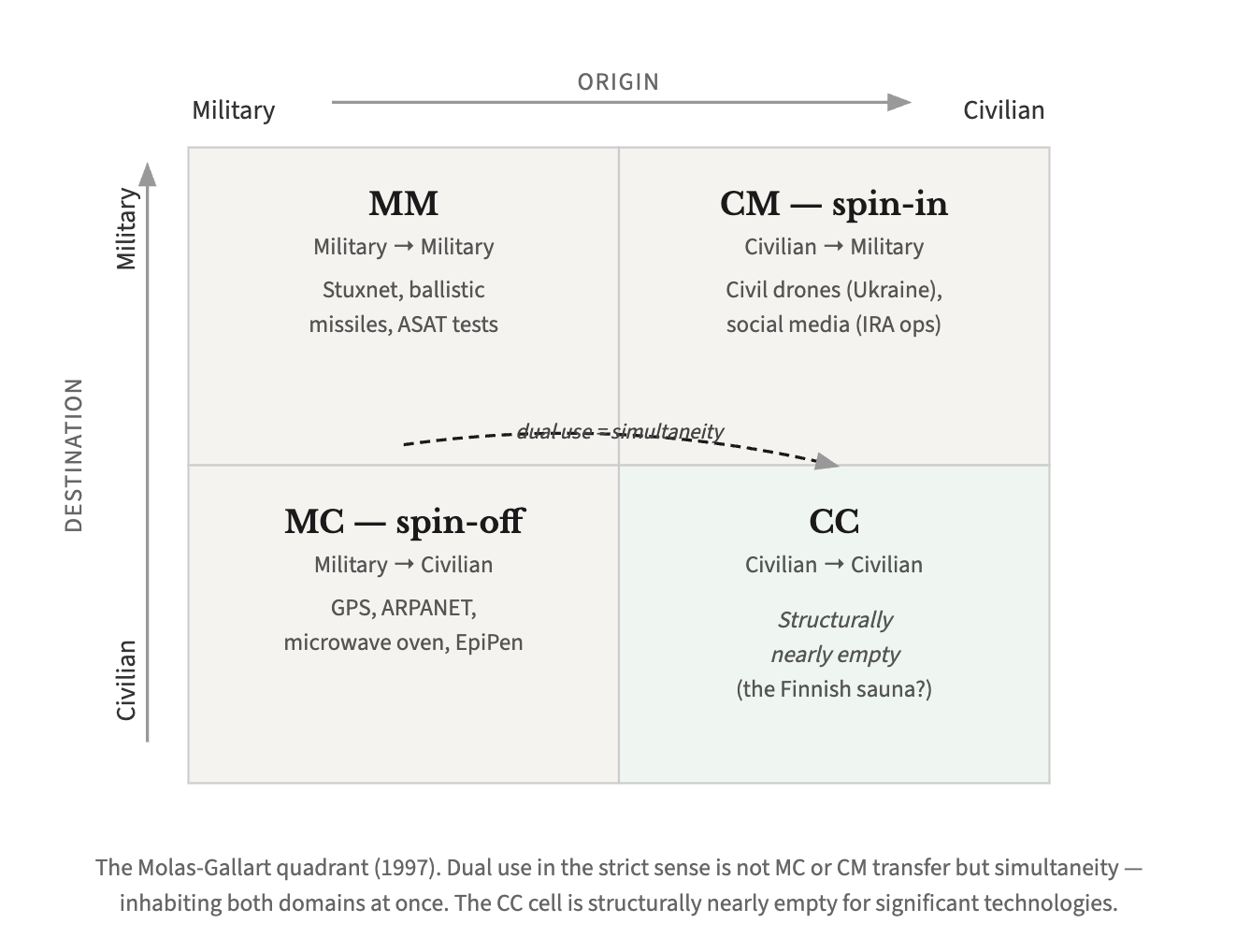
The framework works well for specific technologies. GPS is a clean spin-off (MC): born as a US Department of Defense navigation system, it became global civilian infrastructure. Dynamite is a textbook spin-in (CM): Nobel invented it for mining in 1867; the military adopted it immediately. The stress-test case is Fritz Haber, who synthesised ammonia for agricultural fertilisers in 1909 — an innovation estimated to have fed a billion people who would otherwise not have survived — and whose chemistry also produced the explosives of the First World War. Haber then led the development of chlorine gas as a weapon at Ypres. One researcher, one chemical discovery, every quadrant simultaneously.
The problem emerges when you try to populate the CC cell. What significant technology originates in a civilian context and remains exclusively civilian? The most resistant candidates are the Finnish sauna and the bicycle — but there were bicycle infantry units in the First World War. Recreational mathematics gave us cryptography, which gave us Enigma. Psychological therapy was adopted by the US Army for combat resilience training from the 1970s onward. The printing press facilitated the mass distribution of military manuals and war propaganda. CC is structurally nearly empty for technologies that actually matter. Any technology with physical effects on the world, capable of generating or organising information, or enabling coordination between human beings, has military applicability by construction.
The Quadrant Is the Apex, Not the Floor
Up to this point, the Molas-Gallart framework has been presented as if it were the ground level of the model. It is not. It is the ceiling — the most concrete, most derived level, furthest from the underlying structure. This is where the Collingridge dilemma becomes relevant: David Collingridge identified in 1980 a paradoxical structure in technology governance. A technology is controllable when we do not yet understand it well enough to know what to do with it. By the time we understand it, it is so embedded in the social and economic fabric that control is only practicable in the form of partial exemption. We classify technology when it is still specific; by the time it becomes pervasive, the classification is already obsolete. This explains structurally why the term dual use always functions too late.
The structure underlying the quadrant is better understood as a pyramid — inverted from usual expectation, with the most concrete level at the apex and the most foundational at the base.
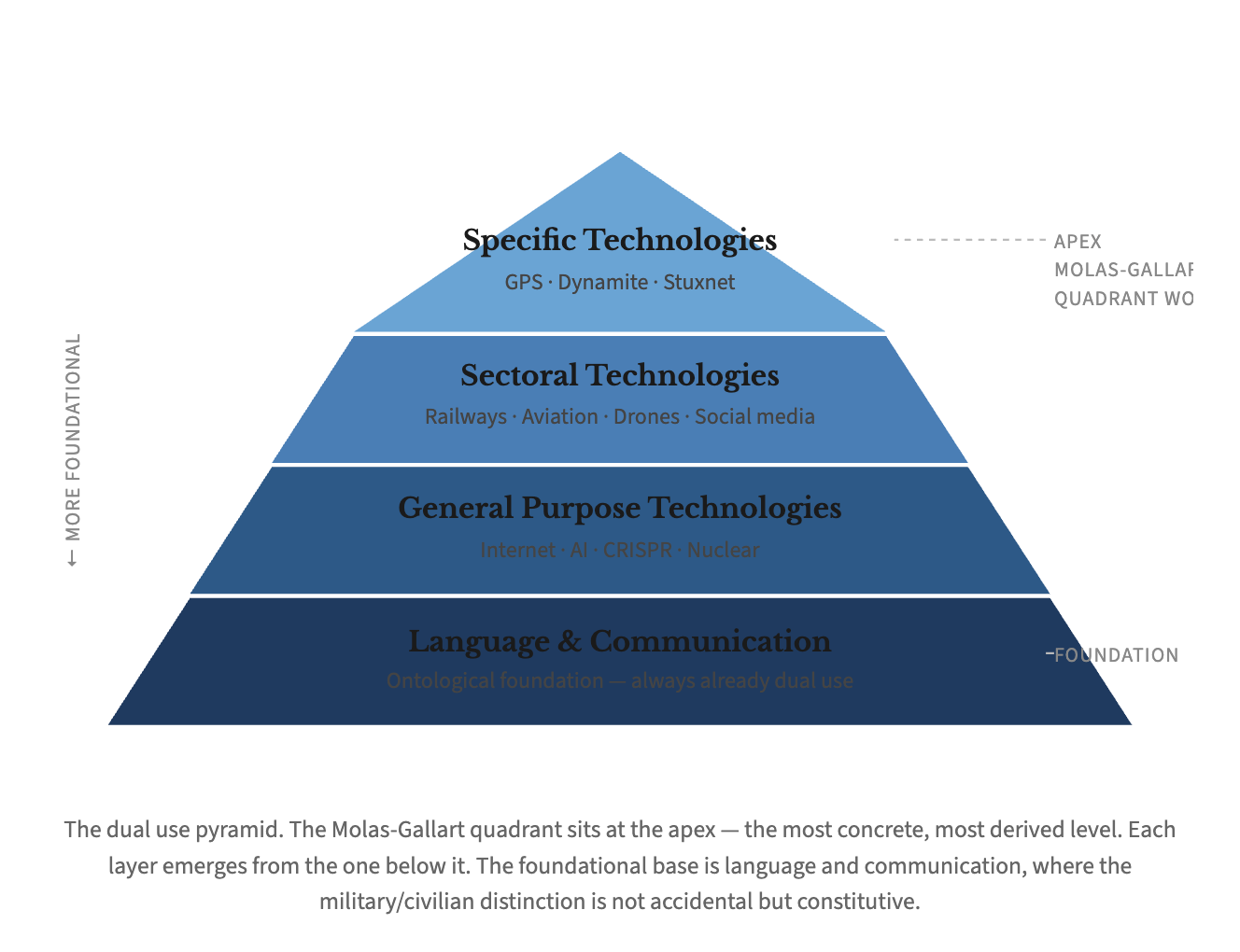
At the apex: specific technologies, the quadrant functions. CC is nearly empty even here, but spin-off, spin-in, and simultaneous dual use are analytically distinguishable.
At the second level: sectoral technologies — railways, aviation, drones, social media — pervasive enough to systematically cross the quadrant’s borders, still analysable by temporal trajectory. The framework holds partially, but migration is rapid and often unpredictable.
At the third level: general purpose technologies (GPTs), as defined by Bresnahan and Trajtenberg (1995): technologies that improve over time, apply pervasively across all sectors, and generate complementary innovations at systemic scale. The internet, AI, CRISPR, nuclear energy. For GPTs the origin/destination distinction is structurally inapplicable: a technology that permeates all sectors simultaneously inhabits both domains by construction. What Katja Bego calls patriotic tech — companies structurally integrated into both military and civilian domains without any transfer event — is the organisational form of the GPT at the moment geopolitics takes it seriously. Alessandro Aresu had articulated the theoretical frame: national security absorbs all economic instruments. Adam Smith, with considerably more elegance, had said the same centuries earlier: “Defence is of much more importance than opulence.”
At the foundational base: language and communication. This is not a fourth type of technology — it is the condition of possibility of all technologies at all levels. Language does not become dual use: the military/civilian duality is not accidental to it but constitutive. Harold Innis showed in 1950 that every major communications infrastructure in history is simultaneously an instrument of military, commercial, and cultural power, without remainder. Paul Virilio radicalised the argument: communication speed technologies are structurally war technologies, because militarising transmission speed means militarising perception, and militarising perception means militarising culture. When in 1914 the British cable ship CS Alert cut Germany’s submarine telegraph cables in the North Sea, it was not treating those cables as neutral communications infrastructure — it was destroying a power architecture Germany had built for precisely that function. The Thurn und Taxis live at this level. They always did.
The pyramid is not a hierarchy of importance: it is a hierarchy of foundation. Every upper level emerges from the linguistic base.
Why Diffusion Does Not Always Dilute Risk
One implicit assumption in the dual use debate is that technological diffusion reduces risk: the more actors use a technology, the less any single one can weaponise it monopolistically. The assumption is partially founded but not generalisable — and its exceptions are the most relevant cases. The relationship between diffusion and risk is not monotonic: it depends on the technology’s structure, actors’ rationality, and the availability of deterrence mechanisms.
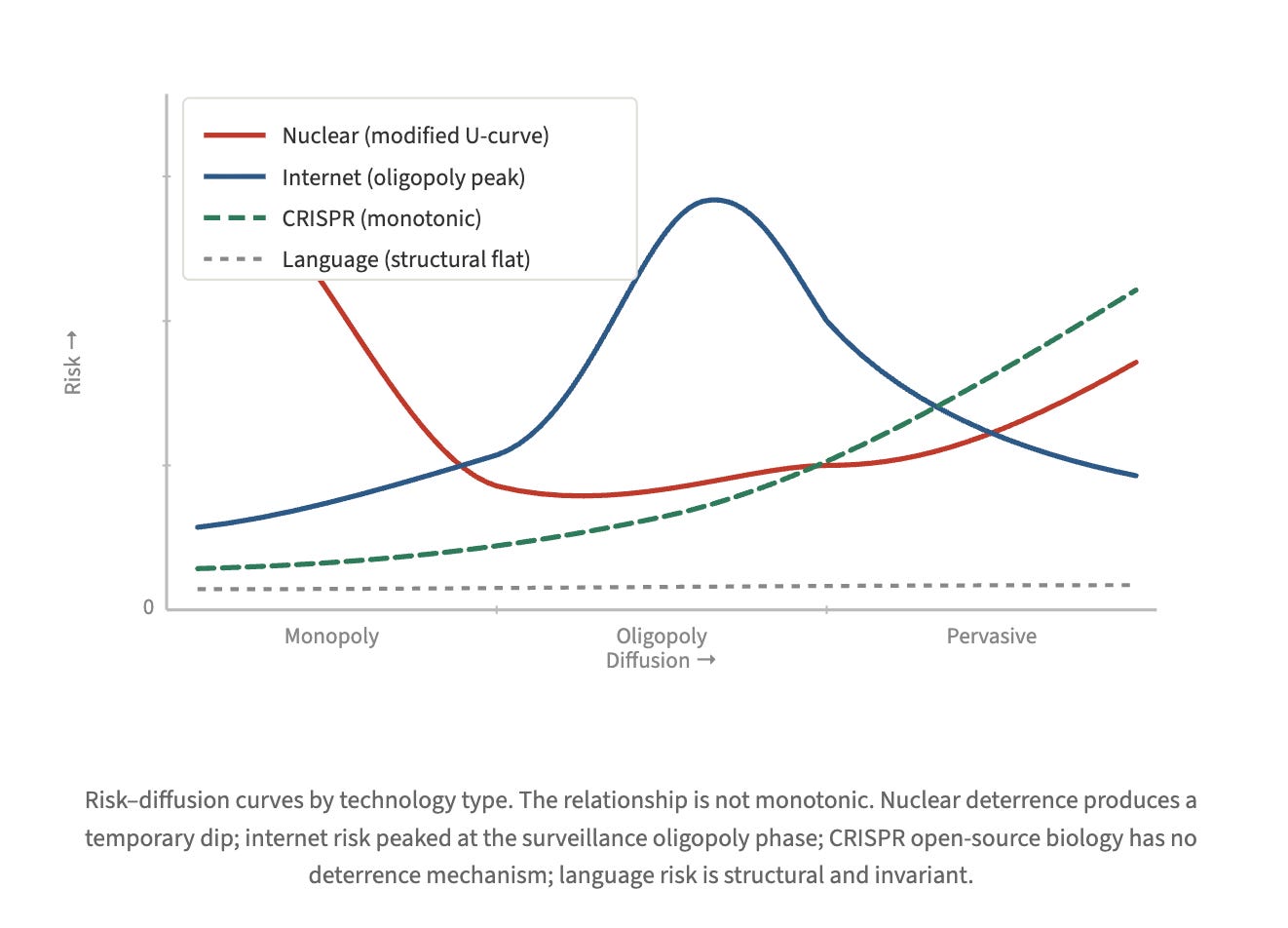
Nuclear follows a modified U-curve: very high risk at American monopoly (1945–1949), relative reduction under bipolar MAD deterrence — where mutually assured destruction produces a paradoxical stability — and a dangerous rise again with proliferation to states not fully deterrable by rational calculation. The internet follows a different curve: low risk in the academic phase, peak at the oligopolistic stage — mass surveillance, weaponised dependency, Tempora, PRISM — then gradual dilution with pervasivity. Open-source CRISPR biology has the most troubling curve: monotonically increasing with diffusion. No deterrence mechanism exists for non-state actors with laboratory skills and a few hundred euros of reagents. The protocol published in Nature is already a potential weapon — epistemic transparency, a founding scientific value, becomes a risk multiplier. Language has a flat curve near zero — not because it is harmless, but because it has never had a monopoly or oligopoly phase. Its risk is structural and invariant. But if you threaten its conditions of existence — the capacity to distinguish true from false — everything above it in the pyramid is endangered.
The Communication Foundation: ARPANET, Cables, Satellites
Fred Turner documented in 2006 how the countercultural narrative of the internet — Stewart Brand, the Whole Earth Catalog, Silicon Valley as hippie capitalism — was deliberately constructed on top of infrastructure financed by the US Department of Defense. ARPANET was born as a military communications system designed to survive a Soviet first nuclear strike. The countercultural narrative produced a systematic dissociation: the military origin was covered by the story of the network as free, horizontal, emancipatory space. This dissociation is not innocent: it is the mechanism that made it possible to treat digital communication as a civilian discipline by definition, leaving the highways open.
Subsea optical cables carry roughly 95% of global internet traffic. They are private commercial infrastructure, financed by tech company consortia. They are also, simultaneously, the object of GCHQ’s Tempora operation — systematic traffic interception at British landing stations — and a Russian strategic target: the Russian Navy maps cables in the North Atlantic with specialised submarines. Nicole Starosielski (The Undersea Network, 2015) showed that cable routes follow nineteenth-century British imperial trade routes: the physical topology of the internet is a colonial topology. Katja Bego’s forthcoming book Deep Connections: The Hidden Battles to Control Subsea Cables (Polity, 2026) documents what this looks like today: Russia mapping North Atlantic cables, China building alternative Pacific routes through HMN Technologies, the US blocking Chinese cable projects in the Pacific islands. The ocean floor is now crowded.
Starlink is SpaceX commercial infrastructure, the system that allowed the Ukrainian army to maintain communications after 2022, and the system the Trump White House threatened to disable in February 2025 to pressure Kyiv into signing a minerals agreement. Civilian infrastructure, with a kill switch held by a private individual, inciding on the outcome of a war in Europe.
Karp Is Right About the Premise
Karp’s 2026 argument — “Silicon Valley has a moral debt to the country that made its rise possible,” the engineering elite has “an affirmative obligation to participate in the defense of the nation” — rests on the claim that everything above confirms: all technology is dual use, no principled distinction holds between civilian and military AI. The premise is true. The conclusion — that this eliminates the case for regulatory constraints — is a non sequitur of considerable commercial convenience.
If dual use is structural, the logical consequence is not the abolition of normative constraints but their multiplication and refinement. A technology that simultaneously inhabits the civilian and military domain requires more sophisticated governance mechanisms, not fewer. Karp takes a correct premise — there is no neutrality — and derives its opposite: since everything is dual use, nothing needs to be regulated. It is like arguing that since all food can be toxic at sufficient doses, toxicology is unnecessary. The premise is true; the conclusion serves a specific commercial interest.
The EU AI Act does not cover military and national security applications. Bego (2026) notes that this distinction “is becoming increasingly porous” — an admission that the regulatory category is already overtaken by the reality it is supposed to govern. That the regulation irritates the current US administration is perhaps an indirect signal of its relevance; that it excludes defence is the limit that hollows it out.
In today’s splintered scenario — sovereign stacks, sovereign clouds, weaponised interdependencies — the same analytical vagueness that once produced impunity through opacity now produces impunity through inevitability. The world is fragmented, every state builds its technological infrastructure as a strategic asset, and dual use is no longer denied: it is declared and used as justification for total integration. The open internet of the 1990s was a cooperative iterated game: all actors benefited from the shared infrastructure, the cost of unilateral defection was high. The US and UK began defecting silently through mass surveillance — PRISM, Tempora, cable interception. The defection was invisible until Snowden made it public in 2013. Axelrod had shown that tit-for-tat produces stable cooperation in iterated games, but requires that defection be visible. Once it was, the logic produced its predicted outcome: collapse of trust, race toward sovereign stacks, the splinternet as the Nash equilibrium of the revealed game.
The cultural effect is where cable geopolitics stops being a technical question. The epistemic commons — the space of shared knowledge the open internet had produced, imperfectly and asymmetrically — is fragmenting into separate commons, with different grammars, incompatible verification systems, diverging archives of collective memory. This does not merely produce different internets: it produces different cultures, in the most literal sense. When cultures diverge sufficiently, the language that should permit communication between them — the foundational base of the pyramid — begins to function differently in its different instances. The words remain the same; the referents change; communication continues but shared meaning erodes.
The final question is not whether Karp’s AI is dual use. The answer is obvious. The question is whether a cultural common ground still exists, intact enough for the question to land with interlocutors who share enough of our reference system to understand it. And whether there is still space for a global infrastructure resembling the one Maximilian I wanted so urgently for his empire — but to the benefit not only of the emperor and the Empire, but of everyone.
This is the third piece in a series applying game theory and communication theory to contemporary geopolitics. Previously: Endless Games and When Winning Is Losing.
The full Italian version, with interactive visualisations and complete bibliography, is at claudiocammarano.com.
Selected references:
Aresu, Alessandro, Le potenze del capitalismo politico. Stati Uniti e Cina, La Nave di Teseo, Milan, 2020.
Bego, Katja, “How a surge in defence and dual-use technology investment could reconfigure the global AI race”, Chatham House Research Paper, International Security Programme, London, April 2026.
Bego, Katja, Deep Connections: The Hidden Battles to Control Subsea Cables, Polity Press, Cambridge, September 2026 (forthcoming).
Bresnahan, Timothy F. and Trajtenberg, Manuel, “General Purpose Technologies: ‘Engines of Growth’?”, Journal of Econometrics, vol. 65, no. 1, 1995, pp. 83–108.
Collingridge, David, The Social Control of Technology, Frances Pinter, London, 1980.
Innis, Harold A., Empire and Communications, Oxford University Press, Oxford, 1950.
Lefebvre, Vladimir A., The Structure of Awareness: Toward a Symbolic Language of Human Reflexion, Sage Publications, Beverly Hills, 1977.
Molas-Gallart, Jordi, “Which Way to Go? Defence Technology and the Diversity of ‘Dual-Use’ Technology Transfer”, Research Policy, vol. 26, no. 3, 1997, pp. 367–385.
Museo dei Tasso e della Storia Postale, Cornello dei Tasso, Bergamo, museodeitasso.com.
Reppy, Judith, “Dual Use Technology: Concepts, Issues, Prospects”, Cornell University Peace Studies Program, Occasional Paper no. 17, Ithaca, 1999.
Segal, Adam, The Hacked World Order: How Nations Fight, Trade, Maneuver, and Manipulate in the Digital Age, PublicAffairs, New York, 2016.
Starosielski, Nicole, The Undersea Network, Duke University Press, Durham (NC), 2015.
Turner, Fred, From Counterculture to Cyberculture: Stewart Brand, the Whole Earth Network, and the Rise of Digital Utopianism, University of Chicago Press, Chicago, 2006.
Virilio, Paul, Vitesse et Politique, Galilée, Paris, 1977 (Eng. trans. Speed and Politics, Semiotext(e), New York, 1986).
Virilio, Paul, Guerre et Cinéma. Logistique de la perception, Cahiers du Cinéma / L’Étoile, Paris, 1984.
Winner, Langdon, “Do Artifacts Have Politics?”, Daedalus, vol. 109, no. 1, 1980, pp. 121–136.